Wednesday, 13 March 2013

Before Minimalism - An Early Robert Irwin

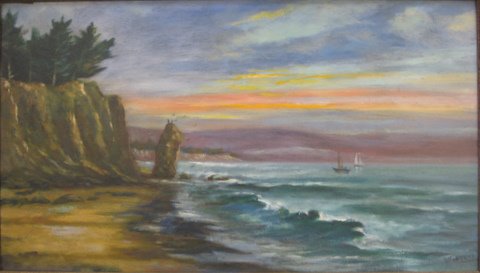
Robert Irwin "Boats" c. 1950 Oil/board

A reader discovered this painting of boats at a Santa Barbara garage sale two years back. After leaving the garage sale, she could not stop thinking about it – and returned to buy it for $150.

Upon seeing that the painting was signed ‘Irwin,’ I was eager to discover its worth. A very famous minimalist California artist is named Robert Irwin (1928-). Although the style is nothing like the works for which Irwin is known, the style and signature is almost identical to his early1950s work.

Robert Irwin is best known for his abstract canvases often depicting lines and dots. He experiments with visual perceptions of color and light. He is primarily a painter but also a sculptor using fluorescent installations.

The question is: does this painting have any value? I always tell my appraisal clients to remember that value is based on many factors. An official appraisal is based on market comparables and takes into account the artist, as well as condition, size, authenticity, provenance, and the current economy. An appraiser also has to consider the style for which an artist is best-known and collected

In consulting auction records, Irwin’s work has sold for as much as a million dollars with most works selling in the $50,000-$100-000 range. Strangely, after discussing the painting with multiple auction houses, they were hesitant to place a high estimate on the painting. 

One auction expert said, “This imagery is not typical of his work.  For this reason, I would worry that the market place might not respond well to this image.  As such, I would estimate this more as novelty paintingat $3,000-$5,000.

The lack of a strong market value is based on the fact that no direct comparables exist. Therefore, auction experts speculate that an atypical work would not be desireable to collectors of Irwin’s typically minimalist work. There are two abstract 1950s workscurrently going to auction that are estimated to sell between $30,000-$40,000. 

While “Boats” would sell for much lower, anumber ofgalleries also sell his work and a painting could be worth up to 30%-50% higher than auction value. Therefore, if this painting were to be appraised for Insurance* purposes, it would be expected to have a retail replacement value of alteast $6,000-$8,000. 

An art find indeed!

Retail Replacement Value is defined as the highest amount in terms of US dollars that would be required to replace a property with another of similar age, quality, origin, appearance, provenance, and condition with a reasonable length of time in an appropriate and relevant market. When applicable, sales and/or import tax, commissions and/or premiums are included in this amount..

Alissa Anderson Campbell is an art appraiser for Anderson Shea Art Appraisals. She specializes in appraising European and American art for insurance, resale value, estate, tax, and charitable donation.Campbellis a member ofthe Appraisers Association of America (USPAP-compliant). Ph. 805.616.2781/www.andersonshea-artappraisals.com

*This is not considered a formal appraisal. An appraisal is a legal document, generally for insurance purposes, written by a qualified expert who has examined the artwork in-person and is paid for by the owner of the item. An appraisal involves an extensive amount of research to establish authenticity, provenance, composition, method of construction, and other important attributes of a particular object. This article is restricted-useand is intended for educational purposes only.

Tuesday, 5 March 2013

Andrew Block: A California Folk Artist

Andrew Block "Lions" Oil on cardboard

A reader submitted this unusual painting with an unusual story. He and his wife purchased it as a Christmas present to each other at Morley Byrant & Co., gallery in Los Alamos, California for $400. The folk-art style oil on cardboard by artist Andrew Block (1879-1969) depicts African lions.

After a bit of research, it seems Andrew “Old Man” Block emigrated from Denmark to Solvang in 1914. Block worked as a blacksmith until he abandoned it for painting at 70 years old. Completely self-taught, Block produced over 500 paintings – and painted primarily on cardboard. Influenced by the impressionists and Post-Impressionists, his works are boldly colored and often depict landscapes, seascapes, and small towns.

Block’s style falls into the genre of Primitive, Naïve, or Folk Art painting-- a style and period of painting often characterized by childlike simplicity in both subject matter and technique. It describes the work of an artist who did not receive formal education, such as Henri Rousseau or Grandma Moses.

Block’s paintings have sold at auction with estimates of $300-$1,200 depending on the medium, size, subject, and date. In the gallery market his paintings are currently listed for sale between $500-$3,000. “Lions” is unsigned, which decreases the value and places it on the lower end of Block’s values. It is in very good condition for being painted on cardboard, a porous and atypical medium for paintings

Although Andrew Block only has a few auction records, Block exhibited his work at a number of museums and galleries including the Monterey Penisula Museum, San Diego Art Museum, Oakland Art Museum, Portland Art Museum, Elverhoy Museum, amongst others. This is important when valuing a work as collectors like to see that major institutions have exhibited an artist’s work.

In the current market, folk art is highly desirable to collectors. The highest auction record for a Folk artist is for Grandma Moses -- arguably the most famous artist of this art movement. One of her paintings sold for $1,360,000 (11/30/2006). Moses’ style and period is similar to "Lions", but Moses’ notoriety sets her values above all other Folk painters. A painting like “Lions” would be desirable on the market -- but sell for much less than considering Block is still a relatively unknown artist.

For Insurance purposes, this painting would have a Retail Replacement Value of approximately $1,000. Retail Replacement Value is defined as the highest amount in terms of US dollars that would be required to replace a property with another of similar age, quality, origin, appearance, provenance, and condition with a reasonable length of time in an appropriate and relevant market. When applicable, sales and/or import tax, commissions and/or premiums are included in this amount.

* This is not a formal appraisal. It is for informational purposes only. An appraisal is a legal document, generally for insurance purposes, written by a qualified expert who has examined the artwork in-person and is paid for by the owner of the item. An appraisal involves an extensive amount of research to establish authenticity, provenance, composition, method of construction, and other important attributes of a particular object. This article is restricted-use and is intended for educational purposes only.


Tuesday, 26 February 2013

California modernist Bentley Schaad up for auction

One of the most interesting California modernist painters working during the mid-century was Bentley Schaad. His work rarely comes up for auction - so I was surprised to see an interesting piece up for sale at Bonhams and Butterfields.
Bentley Schaad "Untitled "Forms" Oil on canvas 24" x 36"

Robert Bentley Schaad was born in Los Angeles, California in 1925.  As a student he went to the Art Center in Pasadena and also attended the Jepson Art Institute and Claremont College.  From his mentor Henry Lee McFee, Schaad learned the principles of painting including line, color, and form.  Schaad was a talented artist and his technical ability enabled him to teach for the majority of his career at Otis. He eventually becoming the Dean of Fine Arts at Otis, teaching many of Los Angeles's best contemporary artists.

Schaad wrote the influential book, The Realm of Contemporary Still Life Painting (New York: Reinhold Publishing, 1962), which served as an instructional text that demonstrates the techniques of line, form, and color theory.  Schaad was known as an aloof and private person but adored by his pupils as a master teacher. 

Schaad is considered a principal figure in the Los Angeles modernist art movement of the mid-century. From his early still life paintings to his geometric constructions, Schaad’s compositions were complex and always had a recognizable aesthetic sensibility. 

For more information on Schaad, go to our website, Anderson Shea Art Appraisals.

Thursday, 23 August 2012

Lopez Baylon "Untitled (Seascape)" Oil/canvas

If one man’s trash is another man’s treasure, this month’s ART FIND is certainly a treasure to one lucky bargain hunter.

Our reader bought this painting by Lopez Baylon during a white elephant sale at Girls Inc. in Carpinteria, California several years ago. She paid $5 for “Untitled (Impressionist Seascape)” and said, “I wasn't sure if it would fit in my dining room but I figured for $5 why not take a chance. I love anything blue and with boats in it.” This time her chance paid off!

Lisandro Lopez Baylon was an artist born in Buenos Aires, Argentina in 1951. He studied at the Pan American School of Art and at the Buenos Aires School of Fine Arts. Baylon he has lived and exhibited in Bolivia, Peru, Ecuador, Colombia, and Venezuela. In the 1970s he traveled to the United States where he was influenced by the landscape of the West. He is often known for his depictions of Western scenes of Native Americans and cowboys.

Baylon also painted many coastal scenes such as this one. Baylon painted in an Impressionist style, using muted, pastel colors and loose brushstrokes. He often paints with a palette knife to achieve a soft Impressionist technique.

In my appraisal research, I found that multiple galleries sell Baylon’s work, which indicates a demand for the artist’s paintings. Comparable paintings currently for sale are listed between $1,500-$2,000. At auction, Baylon's work has sold for up to $900 with one estimated to sell between $800-$1,200 for a Western scene of a horse and cowboy.

In order to assess the most current Fair Market Value, appraisers look at paintings comparable in size, subject, condition, and date for sale at galleries and at auction. As auction pricing is typically less than retail gallery pricing, appraisers find a value somewhere in between when attributing a Fair Market Value.

It is always important to have a Fair Market Value appraisal completed on an artwork you are considering selling. Values are always changing and an appraisal report will give you the most current market analysis of an individual artist’s work. It is important to have values reassessed every 2-4 years so you can be certain a gallery or auction house is offering a fair price.

This Lopez Baylon painting entitled, “Untitled (Impressionist Seascape)” would have a current Fair Market Value of $1,000-$2,000.
-------
Alissa Anderson Campbell is an art appraiser for Anderson Shea Art Appraisals. She specializes in appraising European and American art for insurance, resale value, estate, tax, and charitable donation. Campbell is a member of the Appraisers Association of America (USPAP-compliant). Ph. 805.616.2781/www.andersonshea-artappraisals.com

* This is not considered a formal appraisal. An appraisal is a legal document, generally for insurance purposes, written by a qualified expert who has examined the artwork in-person and is paid for by the owner of the item. An appraisal involves an extensive amount of research to establish authenticity, provenance, composition, method of construction, and other important attributes of a particular object. This article is restricted-use and is intended for educational purposes only.

Tuesday, 7 August 2012

Jack Martin Smith - Gaviota Beach

As an art appraiser I often come upon great paintings with no auction records and no galleries selling the artist’s work – making it hard to value them. This month’s artwork is a lovely painting by Jack Martin Smith -- and was submitted by a Carpinteria, CA resident. Our reader purchased “Gaviota Beach” in the 1990s for $175 (and also got a tour of the artist’s house!) This 29" x 23" painting was also included in a 1993 exhibition of Smith’s work put on by the Carpinteria Valley Art League at our local post office.

Smith (1911-1993) was an art director, perhaps best known for his work on The Wizard of Oz, Cleopatra, and many other major films. Jack Martin Smith was born in California. As a young man, he attended USC. During the 1930s, he lived in Los Angeles and was hired as a set designer for the movie studios.

Smith also painted in both watercolor and oils -- but in the fine art world very few auction records exist and no galleries sell his work. Unfortunately, this makes it difficult for appraisers to assess values. The value of an artist’s work is based on comparable sales records that have occurred in the public art market (both gallery and auction). A paper trail of pricing must exist in order to substantiate value.

In my appraisal research, I found that a gouache painting by Smith’s entitled, “The Emerald City, from the Wizard of Oz” sold for $4,000. The only other painting I could find was a seascape that sold at auction in 2005 for $225. Pricing for “Gaviota Beach” would not be estimated to sell as high as Wizard of Oz painting, a very famous subject and therefore most desirable to buyers.

The technique and subject of Smith’s “Gaviota Beach” would appeal to a number of collectors – but the lack of auction records would make auction houses hesitant to place a high estimate on selling price. An auction estimate for this painting would likely be estimated between $300-$500 based on it’s large size, quality, subject, and condition. If this type of painting were by an artist with stronger auction records and/or galleries, it would be expected to sell for much more.

Many of my art appraisal clients ask how to be sure the art they buy will increase in value. My suggestions is that you buy what you love and not worry about it rising in value. If you do want to invest in art, do some research before purchasing. Buying art by a listed artist with auction records means that the artist’s work already has demand on the market and will likely continue to rise in value.

Alissa Anderson Campbell is an art appraiser for Anderson Shea Art Appraisals. She specializes in appraising European and American art for insurance, resale value, estate, tax, and charitable donation. Campbell is a member of the Appraisers Association of America (USPAP-compliant). Ph. 805.616.2781/www.andersonshea-artappraisals.com

* This is not considered a formal appraisal. An appraisal is a legal document, generally for insurance purposes, written by a qualified expert who has examined the artwork in-person and is paid for by the owner of the item. An appraisal involves an extensive amount of research to establish authenticity, provenance, composition, method of construction, and other important attributes of a particular object. This article is restricted-use and is intended for educational purposes only.

Monday, 25 June 2012

Morris Graves "Untitled (Trees and Houses)" 1934
This month’s ART FIND by the California modernist artist Morris Graves (1910-2001) is entitled “Untitled (Tree and Houses).” Our blog reader inherited two of the artist’s paintings from her aunt, who was a potter at UCLA and knew the artist.

Morris Graves was born in Fox Valley, Oregon. A primarily self-taught artist, he dropped out of high school and began working on a boat during the late 1920s. This enabled him to travel to Japan and China, an influence that would permeate his art throughout his life.

During the Great Depression, Graves worked as an artist for the Federal Arts Project. Upon returning to the northwest, Graves and fellow artists Mark Tobey, Guy Anderson, and Kenneth Callahan founded a school of artists known as "Mystic Painters of the Northwest.” Their artistic philosophy was influenced by the natural world and Eastern religions.

One of the key moments in the Graves’ career was when his artwork was exhibited at the Museum of Modern Art in New York’s "Americans 1942: 18 Artists from 9 States" exhibition

“Untitled (Tree and Houses)” is characteristic of Graves’ style and palette. While Graves worked primarily as an oil painter he also explored tempera, gouache, watercolor, and ink and wax on thin paper in a technique used in Oriental scroll painting.

This painting is signed and dated on the back of the canvas. The artist’s neutral, earth-toned palette incorporates loose brushwork and a thick application of paint. During this period, Graves often painted images of the nature, trees, and animals. “Untitled (Tree and Houses)” was painted during the height of the Depression in 1934. An image of barren tree surrounded by an austere landscape of houses appears to reflect the bleak mood of American history during this period.

In the art market, Graves’ work is highly sought after by collectors and dealers. At auction, his oils have sold for as much as $68,500. His works on paper appear to demand higher prices, with a current mixed media on paper listed for sale at $75,000.

The provenance, defined as the history of ownership for a work of art, is strong in the case of this painting. It came directly from the artist to the current owner’s aunt, thereby increasing the painting’s desirability collectors. In the art market, appraisers always evaluate the provenance of an artwork as it can dramatically effect the value of artworks when the history of it lineage are unknown.

At auction, “Untitled (Tree and Houses)” would likely be estimated between $15,000-$20,000 but could sell for much more depending on the auction house, location, bidders in the room, and other factors. If this painting were appraised for insurance purposes, the retail replacement value would be much higher.

Thursday, 31 May 2012

Lloyd Moylan "Untitled (Sycamores)"/Photo courtesy of private collector

This month’s ART FIND by Western artist Lloyd Moylan is one of my favorite entries yet. When our Santa Barbara, CA reader submitted the painting, it was interesting to discover that she is related to the artist. McMichael has had the painting in her family for many years. She inherited it from her mother who acquired it from her aunt -- who happened to be Moylan’s sister-in-law. The artist likely gave her the painting around the time of his death in 1963. She has never had it appraised.

Lloyd Moylan (1893 - 1963) was born in St. Paul, Minnesota. As a young man, he studied at the Minneapolis Art Institute and the Broadmore Art Academy in Colorado Springs. Eventually made his way to New York where he attended the Art Students League. From 1929 to 1931, Moylan taught at the Broadmore Academy and later became a curator for the Museum of Navajo Ceremonial Art in Santa Fe, New Mexico. His work is held in the collections of the Museum of New Mexico and the Penrose Public Library.

This untitled painting of horses and riders is representative of Moylan’s style and subject-matter. The artist is best known for his depictions of Southwestern desert scenes, landscapes, and images of Native American subjects. Moylan traveled throughout Arizona, New Mexico, California, and Colorado.

Moylan’s signature use of saturated color and his expressive, loose brushstrokes appear to be informed by the European post-Impressionists and Fauvists. In some of Moylan’s other work he explored modernist techniques such a cubism -- breaking objects into rudimentary planes of space.

The art market for Moylan’s work has a wide range of pricing which, like in every art appraisal, is based on age, condition, rarity, artistic merit, technical workmanship, current trends and rarity of an artist’s work. Moylan’s paintings have sold for up to $5,750 at auction. In the gallery market his paintings are currently for sale between $5,000-$10,000 depending on the medium, size, subject, and date.

This painting appears in good condition and at 30” x 20” in size -- is quite large for Moylan’s work. Painted in the artist’s signature style, subject, and palette, this painting would be desirable to many collectors of his work. An art appraiser would also factor in that the painting has not been on the market for many years, thereby increasing its appeal to art collectors. These are all factors art appraisers evaluate when valuing an artwork.

If this painting was to be sold in at a gallery in the California area, it would be estimated to have an appraised retail value between $7,000-$9,000. A treasure indeed!

Monday, 21 May 2012

Henrietta Shore  "Jean Charlot" circa 1927/ Photo courtesy: LACMA
I recently completed an art appraisal of a Henrietta Mary Shore (1880 - 1963) painting for a Santa Barbara, CA art collector. Shore was an innovative painter of her time, often compared to Georgia O'Keeffe.

Henrietta Shore was born in Toronto, Canada and moved to New York City -- where she began her studies at The Art Students League. She learned the technique and style of American realist painting as a student of Kenneth Hayes Miller, Robert Henri, and William Merritt Chase. Shore was one of the founding members of the New York Society of Women Artists. Shore also attended the Heatherly Art School in London as a pupil of the great John Singer Sargent. Shore began exploring modernist techniques of the period. Her foreshortened, magnified botanical studies became known as Abstract Realism.

In 1913, Shore moved to Los Angeles and helped establish the Los Angeles Society of Modern Artists. She was part of a school of West Coast modernist artists who explored new concepts of modernism while maintaining realist subject-matter. Shore won a silver medal at the 1915 Pan-American Exposition in San Diego. She and fellow artist Helena Dunlap had a two-woman exhibition at the Los Angeles County Museum.

Henrietta Shore had earned a strong reputation as an artist and in the late 1920s a retrospective of her work was held at the Worcester Art Museum in Massachusetts. In 1924, she was among twenty-five women chosen to represent American women in Paris. She also traveled to Mexico where she painted portraits of artists Jose Orozco and Jean Charlot.

After returning to California, Shore met photographer Edward Weston, who completed a series of photographs based on Shore’s work. Shore eventually settled in Carmel, CA and continued to paint. During the Great Depression, Shore worked for the Treasury Relief Art Project and completed murals at the Monterey post office and another at the Santa Cruz post office.

Friday, 20 April 2012

ART FIND: Trick of the Eye

Michelangelo Meucci "Trompe-l’œil Still Life of Ducks" 1887

A common question I often get from art appraisal clients is whether they should spare the expense of getting an Insurance appraisal. Most insurance companies require an official appraisal every 2-4 years on artworks valued at over $5,000. This enables collectors to protect your artwork in the case of damage, theft, fire, loss, etc.

In the case of this month’s artwork submission, “(Untitled) Ducks” by artist Michelangelo Meucci -- I would certainly suggest having an official Insurance appraisal completed. Submitted by Santa Barbara, CA area residents, this painting was inherited from their great-uncle's daughter. She studied art in France around the turn-of-the-century and brought the painting back to the U.S.

Michelangelo Meucci (1840-1909) was an Italian artist specializing in trompe-l’œil painting. Trompe-l’œil (meaning “trick of the eye”) was a highly realistic style meant to create an optical illusion. Artists would meticulously paint subjects intended to appear in 3-dimensions. While the style was popular throughout art history, trompe-l’œil painting had a resurgence of popularity both in Europe and the U.S. during the 19th century.

This painting, done in Florence, Italy in 1887, depicts three dead birds hung on a wooden board. The artist’s skillful technique makes the background texture of the painting appear to be wood rather than canvas.

Meucci’s work has sold for up to $12,484 at auction, with most paintings selling in the $3,000-$5,000 range. At 35” x 46” including the frame, this is one of the largest Meucci paintings that has been on the market.

It appears to be in excellent condition and depicts a common subject for Meucci, giving it a value on the high end of his market. If this painting were to be sold in a gallery it would likely be sold for $5,000-$7,000 with an estimated insurance value of up to 50% higher.

As this painting is over 100 years old and highly valuable, an appraiser would strongly recommend having an official insurance appraisal done. Insurance values should be diligently updated every 2 years, even during stable markets. It is particularly important to evaluate works when there are either rapid increases or decreases in market values, such as our current economy.

Artworks that have risen in value, but have not been reappraised at a higher price, will only be insured for the old appraisal price -- in the case of loss, damage, or theft. For artworks that have decreased in value, an updated art appraisal can save clients from overpaying on insurance premiums. Also, if an overvalued artwork is damaged or stolen, an insurer may refuse to reimburse a client for the higher value if it is not a current value (even if the client has been paying a higher premium to protect that overvalued artwork).

This month’s painting, “(Untitled) Ducks” Michelangelo Meucci is quite a treasure! While an insurance art appraisal may seem like an extra expense, it is important to protect a unique and irreplaceable artwork such as this.

-------
READERS: We need your submissions! Please email us a photo of your painting, drawing, or sculpture for next month’s ART FIND.

Alissa Anderson Campbell is an art appraiser for Anderson Shea Art Appraisals. She specializes in appraising European and American art for insurance, resale value, estate, tax, and charitable donation. Campbell is a member of the Appraisers Association of America (USPAP-compliant). www.andersonshea-artappraisals.com

* This is not a formal appraisal. An appraisal is a legal document, generally for insurance purposes, written by a qualified expert who has examined the artwork in-person and is paid for by the owner of the item. An appraisal involves an extensive amount of research to establish authenticity, provenance, composition, method of construction, and other important attributes of a particular object. This article is restricted-use and is intended for educational purposes only.

Wednesday, 4 April 2012

Marion Pike "Clouds & Mountains" Courtesy: Coastal View News

This month’s ARTFIND is painting by Marion Hewlett Pike. The painting, entitled “Clouds & Mountains” was given to the readers' mother-in-law, who met Pike while living at Deer Springs Ranch in Little Sycamore Canyon.

Marion Hewlett Pike (American, 1914-1998) grew up in San Francisco and attended Stanford University where she studied Asian art. She had her first one-artist show in 1955 at the California Palace of the Legion of Honor. Pike also traveled throughout Europe and became known as an established portrait artist.

Pike, along with other women artists of the period attended the important California art schools and explored compelling aesthetic innovations of modernist thought.

Pike was best known for her portraits of Ronald Reagan, Norton Simon, and Coco Chanel but she also painted landscapes and still-lifes. The painting, “Clouds & Mountains” was likely painted around 1953 while Pike was staying at her friend's ranch in Malibu after her husband left her. One of Pike’s first pastel paintings, the dark palette and ominous black mountains appear to reflect her sad spirits of the time.

Marion Pike is considered a listed artist but her auction sales are limited. A gallery recently sold a comparable work for $650. At auction, a small painting sold at for $485. As “Clouds & Mountains” is of a higher quality than the one sold at auction, it would be estimated to have a higher value. The painting is also quite large (18"x24") and appears to be in good condition. It is in the original frame, which can add value to a painting, when it is being appraised. In a gallery setting, retail pricing is often double to triple auction pricing.

A growing demand exists for early California paintings but, still, the selling prices for quality works by most women artists is still not at the level of their male colleagues.

If I were do an official appraisal* for Insurance purposes, I would take into account the pricing comparables, size, provenance, and condition. As appraisers, we also factor in quality, rarity, and the increased value of a painting that has not been on the market for nearly 50 years.

Marion Pike’s “Clouds & Mountains” would have a Retail Replacement Value for Insurance of approximately $1,000. Keep in mind that values can change quickly and insurance companies require art appraisals to be done every 2-4 years on artworks.

Retail Replacement Value is defined as the highest amount in terms of US dollars that would be required to replace a property with another of similar age, quality, origin, appearance, provenance, and condition with a reasonable length of time in an appropriate and relevant market. When applicable, sales and/or import tax, commissions and/or premiums are included in this amount.

Thursday, 8 March 2012

Women Artists of California Modernism

Helen Lundeberg "Microcosm and Macrocosm" 1937 (photo courtesy: LACMA)
Some of the most interesting artists I come upon as an appraiser are a group of modernist artists who also happened to be women. Less recognized and undervalued on the art market include artists Helen Lundeberg, Lucretia Van Horn, Elsie Palmer Payne, Marion Randall Parsons, Florence Lundborg, Helen Forbes, and others. These artists attended many of the same southern California art schools as their male counterparts -- and explored equally compelling aesthetic innovations and modernist thought.

Jae Carmichael (1925-2005) was born in Los Angeles, CA and worked as a painter, sculptor, and photographer. Carmichael studied at Mills College and earned a BFA and PhD from the University of Southern California. She studied art with artists Francis de Erdely, Millard, Sheets, Phil Dike, Dong Kingman, and William Gaw. One of the rare women in the field, Carmichael organized over 200 solo exhibitions in galleries in Los Angeles, Japan, and Europe. Carmichael also served as founding director of Pasadena’s Pacific Asia Museum.

She was also a member of the American Watercolor Society and the California Watercolor Society -- and was a director of the Pasadena Society of Artists. Her work is known for its flattened, cubist style and unique subdued palette of color. Her paintings are included in permanent collections of the Oakland Museum of California, the Long Beach Museum of Art, and the San Francisco Museum of Modern Art, among others.

Jae Carmichael "Twin Peaks, San Francisco" 1950 (photo courtesy Oakland Museum of California Art)

-------
I recently appraised a painting by the artist Mabel Alvarez (1891 - 1985) who was was born in Waialua, Oahu in Hawaii. Alvarez’s father was of Spanish decent and as the son of the business manager to the Spanish king, was given the opportunity to move to Hawaii to work as a physician to Chinese and Japanese immigrants. He was later the personal physician to Queen Liluokalani.

Mabel Alvarez moved to California with her family as a young woman. In 1915, Alvarez attended a prominent art school in Los Angeles directed by William Cahill. As a student, she painted a mural for the Pan-California Exposition in San Diego, which gained her acclaim in the art community.

In 1918, she began experimenting with symbolism, a surrealist style influenced by Will Levington Comfort, a Los Angeles philosopher of the period. In 1931, she became acquainted with Stanton MacDonald-Wright and Morgan Russell, founders of the Synchromy art movement. As a pupil of Matisse and Cezanne, the Synchromists were interested in explorations of color and rhythm. Alvarez became profoundly interested in the movement and produced some of her most important early paintings.

In 1937, Alvarez returned to Hawaii for a year and painted portraits, figure studies, and still lifes. During trip to the Caribbean islands in the 1950s led to a lightening of her palette and her use many oranges, reds, and bright pinks in tropical scenes. Later travels to Mexico reinforced these tendencies. As she got older, she often painted religious and symbolic subjects.


Mabel Alvarez "In the Garden" (photo courtesy: CSU Pomona)
----
Another of my favorite women artists is Ely De Vescovi (1910 - 1998), an artist who has fallen to relative obscurity after having innovated a great modernist technique. A pupil of muralist Diego Rivera in Mexico City, she she assisted Rivera in completing public murals commissioned by the Mexican government. Her first work with Rivera was repainting his infamous Rockefeller Center mural, "Man at the Crossroads," which was destroyed in New York. 

De Vescovi assisted Rivera in his revolutionary discoveries of modern fresco techniques by creating a way to retouch a fresco after it had dried. Her formula used equal parts butanol and water that could be applied with an airbrush every four hours to keep the plaster moist. De Vescovi also found a way to grind cadmium pigments into a fine texture to be used in frescoes. 

De Vescovi was commended by the art community for such innovations. She became a family friend of Rivera and Frida Kahlo. In 1935 De Vescovi displayed her oil paintings and watercolors including landscapes, figures, and still lifes.

In 1938, she travelled to the United States and during the 1940s she painted murals throughout southern California including the Los Angeles's Sawtelle Psychiatric Hospital. Her landscapes and portraits often depicted religious iconography and theology. De Vescovi was a close friend of muralist Jose Orozco, who also worked in California. She never returned to her native Mexico. Unfortunately very few of her paintings can be located.


Thursday, 16 February 2012

ArtFind: Appraising a California Landscape

Charles R. Williams "Untitled California Coast" c. 1940

For this month’s ArtFind we found a lovely painting by California artist Charles Raymond Williams.

Our Santa Barbara art collector's grandparents, who lived in Pasadena for 60 years, acquired the painting in either Pasadena or Laguna Beach in the 1940s.

The artist, Charles R. Williams (1877-1950) was originally born in England. As a young man, he moved to the United States and eventually settled in California. Like many artist in the 1920s, Williams was drawn to the artist enclave of Pasadena.

Williams painted throughout California, capturing scenes the desert, coastline, and rolling hills of our Western landscape. His paintings are held in collections throughout California as well as the The Fred Jones Jr. Museum of Art in Norman, Oklahoma.

This painting of the California coastline was likely done toward the end of Charles R. Williams’ career. It is likely a scene in or around Laguna Beach, since that is where the collector's parents acquired the painting. The bold colors, unique composition, and large size (18” x 23”) would make it highly desirable to collectors of early California paintings.

Charles Williams is considered a listed artist and his paintings have sold at auction, with sales in the $700-$1000 range. A similar painting entitled, “Stream in Landscape” recently sold at auction for $1,074.

As an appraiser I would say the painting appears to be in good condition except for some possible abrasions to the paint near the lower section. While the damage is minor, condition is very important to the value of a painting. Collectors in the market expect some slight aging or craquelure, a fine pattern of dense cracking formed on the surface of paintings due to aging on old paintings.

When buying at auction or in a gallery, collectors want to buy artworks in near perfect condition. These art market conditions effect the outcome an appraisal. Any signs of restoration, in-painting, or repairs decreases the appraisal value of even a highly desirable artist.

As an art appraiser specializing in California art, this painting by Charles Williams is one of the strongest scenes I have seen for sale on the market. While minor condition issues would slightly decrease value, it is well composed, painted, and executed. When appraising the value, these qualities place it in the high-range of the market for his work.

A growing demand exists for early California paintings of good quality, as pieces become more rare. If this painting were to be sold in a gallery, it would likely have a retail price between $3,500-$5,000. This Santa Barbara art collector has a treasure indeed!

Thursday, 26 January 2012

Karl Benjamin: Geometric Abstract Artist

(Courtesy of Santa Barbara Museum of Art/www.pacificstandardtime.org)
I often appraise paintings by the California modernists and Karl Benjamin is one of the most interesting of them. He is best known for his revolutionary approach to hard edge painting, working in a style called Geometric Abstraction. Along with Lorser Fietelson, Frederick Hammersley and John McLaughlin, Benjamin and his colleagues exhibited their works in the revolutionary exhibition at Los Angeles County Museum of Art.

Benjamin was born in Chicago and began his art studies at Northwestern University in Evanston, Illinois. During WWII Benjamin but joined the US Navy but after the war was over, he moved to California where he continued his studies at Southern California’s University of Redlands.

Benjamin began his career as a teacher and moving to the artist colony of Claremont, California in 1952, Benjamin began painting. He taught Pomona College and became involved in the growing modern art movement happening in L.A. including designers, artists, and architects. One of Benjamin’s first important exhibits was entitled Purist Painting at the Walker Art Center in Minneapolis. He also exhibited at the Everson Museum of Art in Syracuse, Columbus Museum of Art, Whitney Museum, and Museum of Modern Art (MoMA).

Benjamin was awarded the National Endowment for the Arts Grant for Visual Arts. His paintings are held in the public collections of the Los Angeles County Museum of Art; Museum of Contemporary Art, Los Angeles; Museum of Modern Art, Israel; Oakland Museum, Oakland, CA; San Francisco Museum of Modern Art, CA; Seattle Art Museum, WA; and the Whitney Museum of American Art, NY among others.

Benjamin is acknowledged as a professional, listed artist and is considered to be an American artist with strong market comparables. Benjamin has produced a substantial body of work, which is commonly traded on the art market. According to our appraisal research, a growing demand exists for Benjamin’s paintings -- although the artist’s work has only recently been demanding high prices as auction and in gallery markets.

Gallery markets tend to demand the highest prices. Benjamin’s is considered an important artist for collectors of California modern art. Auction sales records range from $2,196-$42,700 for paintings, depending on the media, size, condition, subject, and quality. Gallery pricing tends to be much higher.

Friday, 23 December 2011

An Invaluable Painting: California Agave


This month's reader submitted a lovely watercolor simply signed ‘Debbie 1985’. A Carpinteria, California resident said she discovered this painting of an agave in an antique store in San Francisco in the late 1990s. After spotting the painting on a shelf in the back office, the gruff shopkeeper pulled the dusty watercolor off the shelf. Although the painting was not for sale, he told our reader to make him an offer. They decided on $80.

After consulting appraisal price databases and auction records I could not locate an artist with the last name “Debbie.” As a first name, there were hundreds of artists with the common first name -- but guesswork made it impossible to confirm the artist.

As an appraiser I often come upon paintings with no signatures, indecipherable signatures, or unknown signatures. Unfortunately, it is nearly impossible for appraisers to assess values without identifying the artist. This is because value are inextricably linked to a specific artist’s history of comparable sales, which includes both auction records and gallery sales. There must be a paper trail of sales to substantiate value.

This watercolor was likely done by an amateur artist with considerable skill. The artist’s use of color, technical ability, and composition is accomplished. As a work on paper it is important to keep it out of direct light and moisture -- but “Agave” is in very good condition with no abrasions, fading, holes, or mold.

While the subject of the painting would appeal to collectors -- without pricing data, this painting’s Fair Market Value would only fall in a “decorative value” range. A decorative value is the price appraisers give to a commercial artwork by an unlisted artist.

Many of my appraisal clients ask how to buy art that will increase in value over time. Purchasing artworks by a listed artist means that the artist’s work is and will likely continue to be sold on the gallery and/or auction market.

Still, the first rule of collecting art is to buy what you love. Trust your instinct and buy art with which you have an emotional, spiritual, or intellectual connection. This way, if it does not happen to have increase in value, at least you love it.

When I asked our reader about “Agave” she said it did not matter to her if the painting was worth only $10 or $1000—because after nearly 20 years it was still one of her favorite pieces of art. Now that is a treasure indeed!

Alissa Anderson Campbell is an art appraiser for Anderson Shea Art Appraisals based in Santa Barbara, CA. She specializes in appraising European and American art for insurance, resale value, estate, tax, and charitable donation. Campbell is a member of the Appraisers Association of America (USPAP-compliant). www.andersonshea-artappraisals.com

Tuesday, 6 December 2011

Samuel Thal: An American Realist

"Jerome's House, 1943" Etching (Courtesy: Smithsonian American Art Museum)
In doing auction price research for a recent art appraisal, I came upon an interesting painting by American artist Samuel Thal (1903 - 1964). His realist style and loose, expressionistic brushstrokes were reminiscent of Van Gogh's early work. I was entranced by the piece and wanted to know more about the artist.

Born in New York City in 1903, Samuel Thal was the son of Russian immigrants. He grew up on a farm in Hadlyme, Connecticut where he formed a love of the countryside. Upon returning to New York City, Thal initiated his art studies at the National Academy of Design, taking sculpture classes at the Beaux Arts Academy and studied painting, drawing, and printmaking at the Art Students League.

Sam Thal became an accomplished painter, illustrator, printmaker, sculptor, and art teacher. Thal spent most of of his life in Boston where he studied at the School of the Museum of Fine Arts and spent many years producing architectural sculpture with George K. Loeser at Harvard University.

By the 1930s Thal was working as a full-time artist and became well-known for his drypoint etchings. While painting, sculpting, and etching, he also assisted in the establishment of the art education programs under the WPA Federal Art Project. Thal also taught life drawing classes at Garland Junior College in Boston, the Boston Architectural Club and the Boston Museum of Modern Art.

Thal’s drypoint etchings are held in collections including the Boston Museum of Fine Arts, Metropolitan Museum, Library of Congress, Carnegie Institute of Art, Bibliotheque Nationale (Paris), Penn State University, Boston Public Library and Harvard Medical School. In 1942, he was awarded the coveted Talcott Prize by the Society of American Etchers; he was also the recipient of several purchase prizes from the Library of Congress.

This painting, "Figure in a Landscape" is a signature piece for Thal, depicting a figure overlooking his farm. Like the American Regionalists and Ashcan painters of the 1930s and 1940s, Thal depicted images of everday life in America.  Thal painted cityscapes, landscapes, still-lifes, and figurative paintings.

After a bit of appraisal research, I discovered that a number of Thal’s paintings have sold at auction. Samuel Thal's auction records range from $600-$4,000 depending on subject, size, date, condition, and provenance. At galleries his prints, including etchings, were being sold for $300-$500.

Thursday, 17 November 2011

John Sykes (1859-1934) California Impressionist

John Sykes “View of Castle Rock, Santa Barbara"
(Originally published in Coastal View Nov. 24, 2011)

When we asked readers to submit artworks for ArtFind, our art appraiser Alissa Campbell of Anderson Shea Art Appraisals, discovered an interesting painting by California Impressionist John Sykes. Our reader lucked out we he unearthed this oil painting, “View of Castle Rock, Santa Barbara” on eBay about five years ago. He paid $500 and wants to know -- how valuable is it now?

Values can change quickly which is why insurance companies require art appraisals to be done every 2-4 years on artworks valued over $5,000. The value of art depends on a number of factors including artist notoriety, condition, provenance, size, and quality. When valuing a painting, an art appraiser also has to consider the current popularity of an style -- and whether the artwork is being sold at a gallery or auction.

John Sykes (1859-1934) was born in England but at age 25 he immigrated to the Unites States. Sykes settled Santa Barbara, California where he would establish himself as an renowned painter and watercolorist. He is best known for his paintings of the California Missions, which were a favorite subject of the artist. Sykes was also known to paint coastal scenes, landscapes, and local architectural views.

Like other artists of the era, Henry Chapman Ford, Alexander Harmer and Mary Stevens Fish --- John Sykes would sketch outdoors and finish the painting in his studio. He was a self-taught artist but managed to establish recognition as an accomplished painter and draughtsman. Sykes’ work is held in the collections of Santa Barbara and San Obispo Historical Societies, as well as the Carmel Mission.

After a bit of appraisal research, I discovered that a number of Sykes’ works have sold at auction. A similar coastal scene entitled “Castle Rock, Santa Barbara” sold in 2007 for $4,313, with other paintings selling for up to $7,000. Sykes’ work is also sold at galleries, which indicates a demand for his work on the art market.

In discussing the condition of the painting with the collector, he said that “a couple of minor dings” were repaired on the painting. This minor damage would slightly decrease the value, if it were to be appraised for Insurance purposes. Also, if any issues of authenticity were to arise, the value would be affected. It is important to note that qualified art appraisers assess value - but are not authenticators.

This painting depicts a recognizable image of the Santa Barbara coastline and is fairly large at 24 x 13 ½ inches. If “View of Castle Rock” by “View of Castle Rock” painting was to be sold in at at a gallery would be estimated to have a Retail Value between $5,000-$7,500. A treasure indeed!

*Retail Value is defined as a reasonable amount in terms of US dollars that would be required to purchase a property of similar age, quality, origin, appearance, provenance and condition with a reasonable length of time in an appropriate and relevant market. Unlike retail replacement value (Insurance), retail values do not include any fees or additional costs such as taxes, framing, conservation, restoration and additional commissions. (Source: Appraisers Association of America)


----------------
©2011 Alissa Anderson Campbell, Santa Barbara, California. All Rights Reserved. This is not an appraisal. Authenticity is not guaranteed. This article is for educational purposes only. None of the contents of this article may be reproduced, stored in a retrieval system, or transmitted in any form or by any means (electronic, mechanic, photocopy, recording, or otherwise) without the prior written permission of Anderson Shea Art Appraisals, and the appraiser’s signature. )

Wednesday, 26 October 2011

ART FIND: Western painter J.W. Benson


For this month’s Art Find, a reader submitted a painting by Western painter J.W. Benson. This large painting (5 x 7 feet) was given to the reader’s grandparents by a family dentist from Albuquerque in the 1950's. According to the story, there were times when the dentist would accept paintings in exchange for dental work, which is likely how this painting came into their family.

As an art appraiser, I often see Western paintings of the desert. There is something about the desert that has long-inspired artists – and artists like the American painter Georgia O’Keeffe’s most important work came only after she abandoned New York City for New Mexico –never to return from the desert.

J.W. Benson is certainly one of those painters who found inspiration in painting the vast, arid, and mysterious desert. For an artist like Benson, the abundant beauty and color that existed in the desert served as his greatest muse.

Jacob William Benson (1895-1958) was born in Thurmond, Iowa. As a young man, Benson moved West and began painting cowboy scenes in an around Wyoming. A painter and a muralist, Benson was commissioned by local ranchers to paint scenes of their homes and ranch buildings. He also produced sketches for postcards. Benson also traveled throughout the West, painting scenes of New Mexico, Arizon, and Utah.

This painting of New Mexico’s San Esteban Del Rey Mission at the Acoma Pueblo outside of Albuquerque, likely came from these travels. The Mission completed during the 1600's, but the Pueblo itself was established during the 12th-century. Interestingly, our reader’s ancestors originally emigrated from Spain and settled in New Mexico.

With bold colors and loose, sweeping brushstrokes – Benson depicts the Mission dwarfed by the large, undulating desert cliffs in the foreground. Like the 19th-century Romantic painters Benson’s appears to be interested in the humbling power of nature over man. He depicts and earth-toned Mission contrasted by magnificent monumental desert bluffs and sky.

In my appraisal research, I found that few auction records and galleries could be located for Benson’s paintings. Some of his postcard images have sold for minimal values. Unfortunately, without strong market comparables it is difficult to establish an appraisal of value on artworks. While the technique and quality of Benson’s "San Esteban Del Rey Mission” is highly accomplished, the lack of auction records would make auction houses hesitant to place a high estimate on selling price. The Auction Replacement Value* of this painting would likely be estimated between $800-$1,000 based on it’s large size, quality, subject, and condition. If this type of painting were by an artist with stronger auction records and/or galleries, it would be expected to sell for much more.

* Auction Replacement Value is defined as “a reasonable amount in terms of US dollars which would be required to replace a property with another of similar age, quality, origin, appearance, provenance and condition within a reasonable length of time in an appropriate and relevant auction market.” (Appraisers Association of America)

-------
Alissa Anderson Campbell is an art appraiser for Anderson Shea Art Appraisals. She specializes in appraising European and American art for insurance, resale value, estate, tax, and charitable donation. Campbell is a member of the Appraisers Association of America (USPAP-compliant). Ph. 805.616.2781/www.andersonshea-artappraisals.com

Thursday, 29 September 2011

ART FIND: Mid-Century California Painter

Herb Kornfeld "Boats" Oil on board
(Originally published in Coastal View News, September 29, 2011)

When we asked readers to submit artworks to ART FIND, we got a great entry from Carpinteria, California resident and Coastal View News publisher Michael VanStry. As an art appraiser, I have special interest in mid-century paintings done in Santa Barbara and the Central Coast. When I saw Mr. VanStry’s painting by California artist Herb Kornfeld, it was a perfect example of California modernism.

Mr. VanStry acquired the painting approximately five years ago at a silent auction held at the Casa Pacifica Wine & Food Festival in Oxnard, CA. He noticed it right away -- but the opening bid was more than he could afford. After the auction ended Mr. VanStry decided to ask the organizers how much they would take for the unsold painting. He purchased it for $300.

The artist Herbert Kornfeld was born in Great Falls, Montana in 1915. After moving to Los Angeles as a young man, he attended the Chouinard School of Art under the mentorship of artist Palmer Schoppe. Like many artists of the period, Kornfeld traveled to Europe where he was exposed to the modern art movement going on in France, England, and throughout Europe.

Upon returning to California, Kornfeld settled in the Los Angeles area. He often painted the California coast including seascapes, boats, and scenes of everyday life in Monterey, San Luis Obispo, Pismo Beach, Santa Barbara, and elsewhere. Kornfeld also painted in China, Mexico, and throughout the U.S.

Kornfeld's paintings can be found in private and public collections throughout the world. He has exhibited at the Long Beach Museum of Art, The Downey Museum of Art, The U. S. Navy Museum, Charles M. Russell Museum, Chesapeake Bay Maritime Museum, and The American Academy of Arts.

The painting, “Boats” by Herb Kornfeld is a quintessential representation of his coastal subjects. With bold use of color and loose, flat brushstrokes -- Kornfeld’s uniquely modernist aesthetic transforms simple boats into geometric, cubist forms. The painting appears in good condition with no signs of damage.

In my appraisal research, I found that a recent auction records for a comparable Kornfeld painting sold for $950. Multiple galleries sell his work, with large paintings selling for as much as $6,300. A growing demand exists for artworks by California modernists -- and the style, technique, and brushwork of Kornfeld’s “Boats” make it a desirable subject for collectors of California modernism.

Fair Market Value is defined as “the price at which the property would change hands between a willing buyer and a willing seller, neither being under any compulsion to by or to sell and both having reasonable knowledge of relevant facts.”

If this painting was to be sold in a gallery, it would likely be priced between $4,000-$5,000.

------

Please submit your painting, drawing, or sculpture for next month’s The Art Appraiser. Email us a photo and brief description.

Alissa Anderson Campbell is an art appraiser for Anderson Shea Art Appraisals. She specializes in appraising European and American art for insurance, resale value, estate, tax, and charitable donation. Campbell is a member of the Appraisers Association of America (USPAP-compliant). Ph. 805.616.2781/www.andersonshea-artappraisals.com


©2011 Alissa Anderson Campbell, Santa Barbara, California. All Rights Reserved. This is not an appraisal. Authenticity is not guaranteed. This article is for educational purposes only. None of the contents of this article may be reproduced, stored in a retrieval system, or transmitted in any form or by any means (electronic, mechanic, photocopy, recording, or otherwise) without the prior written permission of Anderson Shea Art Appraisals, and the appraiser’s signature. )

Thursday, 8 September 2011

California Modernist Painter - Ed Reep

Ed Reep "Black Rose" (circa 1950-60)
This month's ART FIND submission is an exceptional painting by California artist Edward Reep. As an art appraiser, I have a particular interest in California Modernist artists. There was a school of artists working in Los Angeles during the mid-century who were made up of an innovative group of painters, printmakers, and sculptors.

Ed Reep, along with artists like Bentley Schaad, Henry Lee McFee, Edgar Ewing, Richard Haines, Francis De Erdely, was experimenting with line, color, and form to develop a unique modernist aesthetic. Unlike many artists on the East Coast who had fully abandon representational painting, the West Coast modernists were utilizing elements of cubism and abstraction to depict modern still-lifes, landscapes, and figures. This painting entitled "Black Rose" by Ed Reep is a signature example of mid-century modernism by a Southern California artist.

Edward Arnold Reep (1918 - ) was born in Brooklyn, NY. As a young boy, his family moved to Huntington Beach, California where Reep gained his arts training at the Art Center School in Los Angeles. As a pupil of California watercolorist Barse Miller, Reep began painting in a regionalist style favored during the period. Reep also studied with California artists like Stanley Reckless, Willard Nash, and Emil Bistram.

During the onset of WWII, Reep enlisted as an artist-correspondent in Africa and Italy. Honing his skills as an artist Reep, was awarded a Guggenheim Fellowship after the War was over. He soon began teaching at a number of southern California schools such as the Art Center School of Los Angeles, Bistram School of Art, and Chouinard Art School. After moving to Greenville, NC to teach at East Carolina University, Reep returned to Bakersfield, CA.

Ed Reep is best known for his modernist aesthetic utilitizing elements of abstraction, and cubism. Reep was interested exploring color and form but as a means of representational painting -- before he began only painting abstract works.

The collector who submitted this artwork to The Art Appraiser, acquired it through an auction. In doing my appraisal research, I found that after purchasing the painting, the collector was contacted by the auction house through which he bought the painting. They said Ed Reep himself had contacted them in order to get in touch with the person who had bought his painting.

Reep, now age 94, said he had some memory of it and thought he painted it in the 1950s-1960s. The fact that it was framed and labeled by Reep indicates that he considered it a worthy work at the time (Reep noted he would not have framed had he not considered it worthy). Reep remembered painting a number of "experimental paintings" like this and thought a black rose would be something interesting to paint.

That painting may have some restoration done to it-- which would slightly decrease value. According to my appraisal research, there is a growing market for works by California artists like Reep. Galleries and auction houses sell his work, which indicates a demand. While it is a strong painting, Reep's noteriety as an artist remains limited to a small collector base.

As in every art appraisal, art appraisers base value of the painting is based on age, condition, rarity, artistic merit, technical workmanship, current trends and availability. A painting of this quality, subject, size, and provenance would be on the high end of Reep's market.

The highest price paid at auction for the artist's work was $2,600. Gallery pricing is higher. If Ed Reep's "Black Rose" were to be listed for sale in a gallery, it would likely be priced between $4,000-$5,000.

Please submit your painting, drawing, or sculpture for next month’s Art Find. Email Us a photo and brief description.

Alissa Anderson Campbell is an art appraiser for Anderson Shea Art Appraisals. She specializes in appraising American art and European art for insurance, resale value, estate, tax, and charitable donation. Campbell is a member of the Appraisers Association of America (USPAP-compliant). Ph. 805.616.2781/www.andersonshea-artappraisals.com


Wednesday, 24 August 2011

Art Find: Carpinteria Flea Market


(Originally published in Coastal View News, August 25, 2011)

When it comes to discovering great art you know digging around at a flea market, thrift store -- or even your garage -- might just be the next great treasure hunt!

What makes art valuable? The answer is this: it depends. Art appraisers base value on such factors as the artist’s notoriety, the condition of the artwork, art market trends, as well as authenticity, provenance, and subject. An art appraiser also has to consider whether the appraisal report is for insurance, resale, donation, or estate purposes.

When we asked readers to submit artworks for this month’s Art Find we discovered a great local Santa Barbara area find. Our Carpinteria resident went treasure hunting about a year ago at the Carpinteria flea market where she came upon a painting of a hawk. She did not recognize the artist and decided to move on. An admirer of hawks, she said she couldn’t stop thinking about it and decided to go back. She bought it for $20.

As an art appraiser, my first big clue was the signature on the lower right corner identifying it as painting by Ethelinda. After some research I discovered Ethelinda Robbins studied art at the University of the Pacific in California. After a traveling throughout the world, she worked as an illustrator in Hawaii and New York City. How this painting got to Santa Barbara we don't know.

Upon moving back to California in 1969, she stopped doing illustration and focused on painting. She also dropped her last name and went simply by Ethelinda. While working in Santa Fe, New Mexico Ethelinda became entranced by the allure of the Southwestern deserts. She painted portraits of Native Americans, wildlife, and horses.

In my art appraisal, I found that collectors of Ethelinda’s work tend to pay the highest amounts for her well-known horse paintings. Paintings currently listed for sale in galleries range from $8,500-$27,000. Auction records are lower, ranging from $2,000-$4,000. Still, the scarcity and size of Ethelinda’s work gives “Hawk Portrait” of a strong market value. While the painting appears to need cleaning, it is in good condition. A demand exists for Ethelinda’s paintings.

The Appraisers Association of America defines Auction Replacement Value as “a reasonable amount in terms of US dollars which would be required to replace a property with another of similar age, quality, origin, appearance, provenance and condition within a reasonable length of time in an appropriate and relevant auction market.”

At auction this painting would be estimated between $5,000-$7,000. A treasure indeed. . .

Please submit your painting, drawing, or sculpture for next month’s Art Find. Email Us a photo and brief description.

Alissa Anderson Campbell is an art appraiser for Anderson Shea Art Appraisals. She specializes in appraising American art and European art for insurance, resale value, estate, tax, and charitable donation. Campbell is a member of the Appraisers Association of America (USPAP-compliant). Ph. 805.616.2781/www.andersonshea-artappraisals.com